|
U vindt dit artikel in de Nederlandse taal in Succulenta No.5 van oktober 2007
Agave xylonacantha Salm Dyck and heteracantha Berger
This article is a copy of an original article in the Dutch journal of the Dutch Cactus and Succulent Society 'Succulenta'' (oktober 2007) and has been translated into English by Jan Kolendo England.
Wim Alsemgeest Jos van Roosbroeck and Theo van ‘t Walderveen

Scan from Agave xylonacantha out of Curt.Bot.Mag. (Collection Roy Mottram England))
History.
Agave xylonacantha,like so many other agaves in the 19 century, was initially discribed by the well known Count Joseph-Maria von Salm-Dyck in 1853 who had an extensive collection of succulents in his castle in Düsseldorf, Germany. At that time every plant coming from a far away exotic country was considered a treasure. Many plants, as we now know, were taken from habitat and found their way not only to varioust botanical gardens but also to the collections of the rich and famous. These people ware so proud and delighted with their plants that they tried to give each individual acquisition an individual botanical status.
So for example, Pampanini, Jacobi, Regel and Berger described numerous plants that we no know to be variations of one and the same plant. Communication at that time were not as rapid as they are now with eg.internet systems and sharing of information was not as speedy as can be achieved in today's times.The consensus currently is that,as far as nomenclature is concerned, the oldest names and descriptions have priority and all newer versions are consigned to history.At present not only many botanists but also many amateurs enthusiasts are busy trying to work out what was done in the past and trying to make some orderout of that chaos. Currently there are some 20 synonyms for Agave xylonacantha and that in itself says a lot.
The older names can still be found in many books and journal articles. Sometimes having an older name is quite useful because it may help in tracing the history of a plant back to an orginal source. In many old botanical gardens one can find plants with their old orginal names and this is more common than in private collections.
Our Plant
Why we refer to Agave xylonacantha in this article as “our plant “ ??
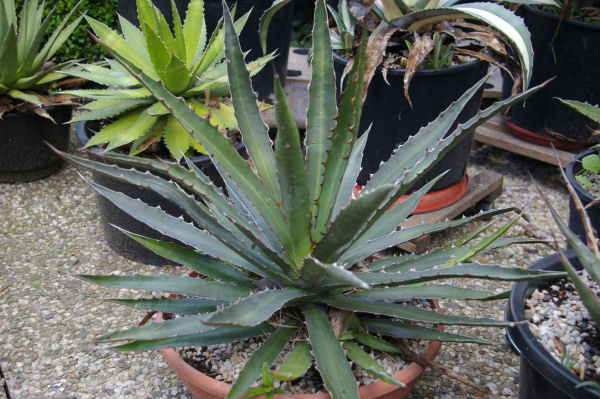
Our plant, not Agave xylonacantha but agave heteracantha
Plants in collections under the name of A. xylonacantha tend to be grey/green in colour, with an light green middle stripe on the leaves. On the underside of the leaves one can see many small stripes and the surfase is often quite rough.Apart from the end spike one can see on of the side of the leaves many variable teeth on broad bases; some are double and some variously flexed and hooked.Apart from the end spine one can see on the side of the leaves many variable teeth on broad bases; some are double and some variously flexed and hooked. The margins of the leaves are initialy brown and later grey and together with the changing of colour of the leaves this makes for a beautiful plant, especially specimens with numerous leaves.
The flower spike is a spicate form, a small column of flowers, and this places the plant in the Littaea group. Theses are the most typical characteristics of the plant.
Our plant grows with an asymmetrical rosette so it is immediately recognisable. We talking here about a specific form , because we are coming to the conclusion that our A. xylonacantha, is the plant we have in our collections not the typical A. xylonacantha but more about this name later. From now we' call our “A. xylonacantha” Our plant!

Two young plants, left the green A.heteracantha and richt the an gry/green seedling of A. xylonacantha
The Asymmetric rosette of “our plant “
There are also small forms of “our plant in the collections, with different names such as A. xylonacantha var. minor, A. univittata and A. univittata var. minor.
You can find a good picture in the first edition of Dr. Thomas Heller’s book “Agaven” on page 128.
Another characteristic growth feature of “our plant” is that the new central leaves of the plant do no grow straight upwards but appear horizontally. We think that the reason is that the plant does not have a typical symmetrical central axis.
This typical growth system you can also find in the plants under the name of A. xylonacantha ,,minor”, A. univittata and A. univittata var. minor.

The "real" agave xylonacantha in cultur collection Jos van Roosbroeck Belgium
Is “our plant” now A. xylonacantha or A. lophantha ?
Our plant look's very much on A. lophantha sometimes also to be found under the name of A. univittata but this latter name is now no longer used under the rules of botanical nomenclature .
Many times you may see “our plant” under the name of A. lophantha but also you can also find hybrids of A. xylonacantha with A. lechuguilla, A. ghiesbreghtii, A. filifera and A. attenuata .
Naturally it is not easy to find out what the correct name of “our plant’ is, as it is a long time ago that these plant were brought from their natural home to Europe and described.
There is an interesting story to be found in Berger's book from 1915 “Die Agaven”. Lt.Gen. G. von Jacobi saw in Count Oswald de Kerchove de Denterghem’s collection plants of A. univittata (now A. lophantha) and A. xylonacantha together in flower . Many seeds were collected later from these plants and so many young plants arose from these two different specimens. Maybe these are the ancestors of “ our plant ”
Agave lophantha is different from A. xylonacantha because of the many smaller teeth but just like A. xylonacantha they also have double teeth. The teeth of “our plant” are much bigger than average and their colours vary from yellow to grey. They are often described as “wooden teeth”. Another important characteristic of A. lophantha is the flat leaves, whereas most of the other agaves, including “our plant ”, have leaves which are concave .

An green and an grey/green form of Agave xylonacantha between Zimapan and Rio Moctezuma
In the natural Habitat
We continue to have doubts that “our plant” is correctly named as A. xylonacantha.
We are now living in such times that many amateurs like us have the possibility to go and look for the the plants in habitat. So we hope that we can solve the mystery of these names and have a lot of fun and pleasure in doing so.
Agave xylonacantha can be found in Mexico at an altitude of 900 metres on the mountains of the eastern Sierra Madre Oriental which extends 1000km from north eastern Mexico to the south. A. xylonacantha is found on different sites sometimes more than 100km from each other so it is easy to understand that a number of different forms occur. There is a fantastic colony on the boundary of the states of Hidalgo and Quararetero, between Zimapan and Bella Vista del Rio.
On that side most of the plants are the grey-green and only a few of the plants have pure green leaves. Apart from the “normal” form, there were also the most beautiful small compact forms, just like jewels!
In November there was one plant in flower with a very short flower stalk which you can see in the picture behind me. The flower-stalk was only 2.5 metres tall. Normally the flower stalk reaches 6 metres in height as in the original description of the plant.

Agave xylonacantha with an broken flowerstalk on the same site
Two years later we were again in the same area and we again found on our route an A. xylonacantha with an short flower stalk. At first we thought we had found an unusual A. xylonacantha form with a short flower stalk, but the final conclusion was that the flower stalk was simply broken. So you can see how easily confusion can occur.
We have also visited the site of A. xylonacantha. near San Luis Potosi, in the neighbourhood of the well know site described by the “Globe Trotters”. The plants growing there are much bigger with more green-yellow colouring of the leaves but they also have the double teeth and the rough underside of the leaves as in the picture.
The third site of A. xylonacantha we visid is in the fames Baranca de Los Venados near Meztitlan, there were we the well known ' Old Man Cactus' the Cephalocactus senilis also grows.
Here one can see many A. xylonacantha hanging on cliff walls. The plants here are only the grey- green variety, without any yellowish/green forms. There are true wall growers on vertical cliffs en that is the reason the leaves have a different form and are also far fewer in number. The leave are long and the plant are not very attractive and generally not recommended for a window display.
The plant you can find down flat onder flatter ground, have more or less the spiral growing system but also in culture you can see that same spiral growing method. These are very ugly plants. Later we find also on vertical cliffs near Bella Vista Del Rio more A. xylonacantha and again the plants there demonstrated spiral growthing with the asymetrical growing as found in "our plant".

If you look at the very old descriptions you find out that the A. xylonacantha plants growing on vertical cliffs adhere to the growth deevelopment described there..
Separate you find in this context the old descriptions.Click here.
In our opinion, the true form of A. xylonacantha is the the ‘ugly’ form growing on the vertical cliffs in the Baranca Meztitlan and also near Bella Vista Del Rio. In the agave bible, the famous book of Howard S. Gentry ‘The Agaves of Continental North America, the author states ‘ the species is abundant on the limestone slopes in the Barranca de Meztitlan, not far from the great mines of Real del Monte’.
Real del Monte is the city not far from the city of Pachuca, in the state of Hidalgo.We now have young plants grown from seed coming from the original site and we discover that these young plant are much greyer in colour than the young offsets from “our plant “, which appear to be much greener. So therefore what is the agave present for an long time in our collection with the name A. xylonacantha and now known only as “our plant” ? Is “our plant” perhaps A. heteracantha?
Alwin Berger
Berger described almost all of his agaves from plants growing in The Hanbury Gardens in La Mortola on the Italian Riviera.
Recently we obtained a copy of the magazine “Die Gartenwelt” from September 1898. There is a description written by Alwin Berger accompanied by a picture in black and white. The picture appears to belong to the description on page “Seite 553”,
, but that is an error and should refer to page 593. This picture and the description brings us to “our plant”.
Berger tried to obtain the paper with the description of A.heteracantha by Zuccarini from 1883 but was not successful.
A. heteracantha appeared in the collection of Jacobi and Salm-Dyck and Salm-Dyck described the stripes on the leaves; Berger concluded that this was the right plant and described it as A. heteracantha A. Berger.
The confusion is complete with the knowledge that there are three different descriptions of A. heteracantha, all taken from different plants.
1. A. heteracantha Baker, Gardeners'Chronicle, 1877: 369, fig. 59.
This name is a synonym of A. ensifera (Gentry, 1982).
2. A. heteracantha Hort. This name is a synonym of A. lechuguilla (Gentry,1982).
3. A. heteracantha Zucc., Acad. Caes. Leop. Carol. 1833 (?), 16(2):675.
This name is a synonym A. lophantha (Gentry,1982).
There is no explanation of any reason why this is so and it has to be pointed out that the first two allocations of A. heteracantha are not based on a study of the literature.
Because the picture of Alwin Berger's A. heteracantha, taken in La Mortola and published in “Die Gartenwelt” from 1898, looks identical to ‘ our plant “ and the description also fits precisely , have we have concluded that “our plant” is the real Agave heteracantha A. Berger.
August J. J. Breitung
In his publication ‘The Agaves’ (1968) Breitung shows a picture of A. univittata var. carchariodonta ( picture 22, page 11).
This plant appears identical to the A. xylonacantha one can find growing near San Luis Potosi. In his book Gentry describes this plant as a synonym of A. xylonacantha.
Curtis’s Botanical Magazine
The beautiful painting in colour in the famous Curtis’s Botanical Magazine from 1876 (see the copy in this article with thanks to Roy Mottram), is the type plant of A. xylonacantha.
This painting is of a plant coming originally from Real del Monte, north of Pachuca, Hidalgo, Mex., not far from the Barranca de Meztitlan. The plant in the painting flowered in Kew Gardens,London in 1876.
You can see the flower-stalk in the painting. If you look at the centre of the plant you can certainly see the similarities to “our plant”.
But one must also realise that if an agave starts to flower then there is also a change in the appearance of the leaves,which become smaller and thinner.
.
If one looks closely at the underside of the leaves of the plant on the painting one can see the typical striped leaves of A. xylonacantha. Also the pattern of leaf growth suggests that the plants are coming from a rock wall originally and so this painting makes a very good lectotype for A. xylonacantha.
The plants growing near San Luis Potosi are different in form. These plant are much bigger and more yellowish-green in the colour of the leaves and also have the typical double teeth , so that these plants also belongs as A. xylonacantha forms, but not to the type of A. xylonacantha growing in the Barranca de Meztitlan.
John G. Baker
Finally, we can also find A. xylonacantha in the book written by Baker in 1888.
Baker was working in the Kew Gardens and had written another book in 1879, that means nine years earlier. This work was translated from the English into Italian by V. Ricasoli.In this book you can find different paintings , also one of Ä.xilinacantha,”, This name is missing one “ o “ and one “ n “. This name is synonymous with A. xylonacantha. One can also find the name “A.xilacantha” in : “Salm-Dyck - Bot. Mag. t. 5660 - Gard. Chron. fig. 81, vol. VII, p. 527“, also representing A. xylonacantha.
The painting of A. xilacantha is a copy from the Gardeners’ Chronicle; it shows the typical cliff-grower plant. However this typical plant has very small leaves, or perhaps this painter has made them smaller. By looking closely at the painting, one can also find the double teeth.
Conclusion
A. xylonacantha is a very variable plant, so it is not surprising that we have for a long time not realised that ” our plant “ does not belong to the true A.xylonacantha.
Now that we have young seedlings available in cultivation with precisely known origins, we can see that these seedlings have the green-grey colour of the leaves typical for the “real ” A. xylonacantha.
The most typical A. xylonacantha grows in the Barraca De Meztitlan as a cliff dweller, with a curved rosette and few leaves. The growth pattern is quite different to the asymmetrical growth of A. heteracantha.
On flat terrain the plants grow with normal shaped rosettes and more numerous leaves. These plants are typically grey-green in colour.
Near Bella Vista Del Rio, on the border of Hidalgo and Quaretaro, one can find the same forms growing as in the Barranca Metztitlan, but in addition there are beautiful miniature forms. In the area between San Luis Potosi and Rio Verde one can find the moreyellow-green forms.
In Alwin Berger’s book on page 114, it is mentioned that C. A. Purpus has collected plants under the name of A.xylonacantha in San Luis Potosi.
Because “our plant” is so much different to the real “A. xylonacantha” our conclusion is that “our plant” belongs to a different taxon, this being the original A. heteracantha Zucc. “Our plant” ,now named as A. heteracantha is a beautiful plant.
There are also smaller forms of this A. heteracantha, we suggest naming these smaller forms A. heteracantha “minor”
The Cultivation of A. heteracantha.
.
The forms of A. heteracantha are very strong and winter hardy. We know the story of a plant in Holland completely forgotten about in winter because it was on the roof of a house. When this plant was discovered by it’s owner it was completely frosted up in the pot, but it appeared to be none the worse from this experience.
We suspect that because this plant is reasonably winter hardy in Europe it can be found in many collections growing without any problems.
Synonyms from A. xylonacantha:
Agave amurensis Jacobi (small form)
Agave carchariodonta Pampanini (1907)
Agave cornuta Hort. Belg. ex Besaucele
Agave heteracantha var. splendens (Jacobi) Terracciano
Agave kochii Jacobi (1866)
Agave hybrida Hort. ex Baker (an hybrid)
Agave maximilliana Hort. ex Besaucele ( small form)
Agave noli-tangere A. Berger (1915)
Agave perbella Hort ex Baker
Agave splendens Jacobi (1870)
Agave univittata var. carchariodonta (Pampanini) Breitung
Agave vanderdonckii Hort. ex Baker
Agave vittata Regel (1858)
Agave xylacantha Hort
Agave xylonacantha var. horizontalis Hort. ex Berger
Agave xylonacantha var. latifolia Jacobi
Agave xylonacantha var. macracantha Jacobi
Agave xylonacantha var. mediopicta Trelease
Agave xlyonacantha var. torta Jacobi
Agave xylonacantha var. vittata Jacobi
Literatuur:
Alsemgeest, W. (2002) : Ervaringen met agaven in cultuur(2). Succulenta, 81 (3): 106.
Baker, Dottore J. G. (1879). Succinto della Monografia delle Agave (vertaald uit het Engels door V. Ricasoli). Bull. Soc. Toscana Orticultura, IV, Firenze.
Baker, J. G. (1877). The Genus Agave. The Gardeners’ Chronicle, N.S. 2, vol. ......., p. 527, fig.81.
Baker, J. G. (1888). Handbook of the Amaryllideae: including the Alstroemerieae and Agaveae, p.168. Bell, London.
Berger, A. (1915) : Die Agaven – Beiträge zu einer Monographie. Fischer, Jena (Idem, ergänzter Nachdruck der 1. Auflage, 1988, Gustav Fischer Verlag, Stuttgart, New York).
Berger, A. (1898) : Agaven - von Alwin Berger Kurator des Akklimatisationsgartens zu La Mortola. Die Gartenwelt, Jg. 2, September 1898, no.49 und 51.
Breitung, A. J. J. (1968) . The Agaves. The Cactus and Succulent Journal Yearbook. Abbey Garden Press.
Curtis’s Botanical Magazin, 18 ........, vol. ........., t. ......(with text): Agave xylonacantha.
Etter, J. & Kristen, M. (2004): A Roundtrip Through San Luis Potosi. Cactus&Co, 8 (2): 69-86.
Garcia-Mendoza, A. (2002). Distribution of Agave (Agavaceae) in Mexico. C.&S.J.(US), 74 (4): 178.
Gentry, H. S. (1982). Agaves of the continental North America. The University of Arizona Press, Tucson.
Hamburger Garten- und Blumenzeitung (Verlag Robert Kittler, Hamburg), 1864, Jg. 20, S. 550-551.
Heller, Th. (2003). Agaven. Natur und Tier Verlag GmbH, Münster
Irish, M. & G. Irish (2000). Agaves and related Plants – A Gardeners' Guide. Timber Press, Portland Oregon.
Jacobi, Generalleutnant G. A. von (1864). Versuch zu einer systematischen Ordnung der Agaven. Hamburger Garten- und Blumenzeitung (Verlag Robert Kittler, Hamburg), S. 455-466, 498-515, 539-562.
Jacobi, Generalleutnant G. A. von (1866). Herzug zu einer systematisichen Ordnung der Agaven. Hamburger Garten- und Blumenzeitung (Verlag Robert Kittler, Hamburg), S. 114-123, 167-178, 209-222, 261-273, 320-331, 353-361, 404-413.
Jacobi, G.A. von (1867). Agave xylonacantha. Hamburger Garten- und Blumenzeitung (Verlag Robert Kittler, Hamburg), S. 555-556.
Jacobi, G. A. von (1869). Nachtrag zu dem Versuch einer systematischen Ordnung der Agaven. Abhandlungen der Schlesischen Gesellschaft fur vaterländische Cultur. Abtheilung fur Naturwissenschaften und Medicin (Breslau), S. 138-176.
Jacobi, G. A. von (1872). Zweiter Nachtrag zu dem Versuch einer systematischen Ordnung der Agaven. Abhandlungen der Schlesischen Gesellschaft fur vaterländische Cultur. Abtheilung fur Naturwissenschaften und Medicin, Breslau, S. 147-175.
Jacobsen, H. (1955) : Handbuch der sukkulenten Pflanzen. Fischer, Jena.
Korevaar, L.C. et al. (1983) Wat betekent die naam. Botanisch Latijn toegankelijk gemaakt.Kon.Van Poll, Roosendaal.
Thiede, J. (2001). Agavaceae. In Eggli, U. (Hrsg.), Sukkulenten-Lexikon, Bd. 1, Einkeimblättrige Pflanzen (Monocotyledonen). Ulmer, Stuttgart.
Ullrich, B. (1991). Agavensystematik für das I.O.S.- Lexicon (1. Vorschlag) 3/1991.
Websites:
www.agaves.nl
www.agavacea.com
The International Plant Names Index (IPNI): http://www.ipni.org
Thanks to Sjef Theunissen the help us with the translation from the original describing from Latin in to Dutch.
An thanks also to Jan Kolendo for the help from the translation from the hole article from Dutch to Englisch.
Many thanks for the help by the translation from Dutch to the Englisch language from Jan Kolendo
Literature:
Breitung, A.J. J. (1968). The Agaves. The Cactus and Succulent Journal Yearbook. Abbey Garden Press, .............
Heller, Th. (2003). Agaven. Natur und Tier Verlag GmbH, Münster.
Irish, M. & Irish, G. (2000). Agaves and related Plants - A Gardeners' Guide. Timber Press, Portland Oregon.
Janse, J. A. (1942). Agaven. Cactussen en Vetplanten, 8: 51-56.
Thiede, J. (2001). Agavaceae. In Eggli, U. (Hrsg.), Sukkulenten-Lexicon, Bd 1, Einkeimblättrige Pflanzen (Monocotyledonen). Ulmer, Stuttgart.
Ullrich.B.Zum Verbreitungsgebiet von Agave victoriae-reginae T.Moore. K.u.a.s. 42(11) 1991 pag.262-263
Ullrich.B. Agave victoriae-reginae T. Moore K.u.a.s kartei heft 7/1991.
Back to article overview
|